
I first wrote this in early 2025, before I had developed it. Six categories of development, an investment metaphor, and a sense that we were measuring the wrong things. Since then the argument has sharpened considerably, first through a policy brief written with Bassem Nasir and then through work on what AI displaces during the years a child is forming. This revision keeps the classroom, updates the framework to where it now stands, and corrects two sources I should not have relied on.
There’s a measurement/assessment habit in education that is very similar to how business optimize their reporting for quarterly financials. Classrooms record what reports cleanly and on schedule: proficiency, benchmark scores, growth percentiles, etc. Those numbers are useful, yet the are also proxies for something they are meant to represent, particularly when there is pressure to ‘grow’ or ‘move’ the numbers forward.
The science of learning and development has been clear for some time that cognitive, social, and emotional processes are not separable systems that happen to co-occur in the same child (Cantor et al., 2019; Immordino-Yang & Damasio, 2007). They are one process with three names. A child who cannot regulate frustration isn’t inseparable from the same one having an emotional problem that then affects her reading. The regulation and the reading are being built by the same architecture at the same time.
If that is true, then a measurement system that tracks one strand and ignores the other two is both incomplete and misleading, because it reports progress on the visible strand while the others go unobserved.
Five holdings
The developmental logic behind the framework I have been developing with Bassem Nasir treats a person's capability as a portfolio, similar to the structure prudents investors care about: composition, sequence, concentration risk, and what keeps the portfolio growing iff one position fails.
Let’s apply to this to human development in 5 core holdings:
Foundational skills. Deep reading, mathematical automaticity, the capacity to stay inside a problem that resists. These are built earliest and through the narrowest window. Automaticity that does not arrive on schedule makes every later task heavier, because attention is still being spent on what should have become free (Stanovich, 1986).
Human encounter. Peer friction, mentorship, the experience of being consequentially wrong in front of someone whose opinion matters. Built continuously and only through genuine others. This is where the tolerance for disagreement is built, and it cannot be simulated because simulation removes the stake.
Domain expertise built before extension. Knowledge a student acquires through her own effort, which is what later allows her to direct technology over accepting only what it produces. The sequence is not incidental. Expertise must be built first.
Cultural and linguistic capital. Fluency in a child's own context, language, and inherited ways of making sense or knowing. The holding most exposed to displacement by systems trained on someone else's corpus or academic perspective. The most at risk from mass adoption from Western AI technology.
AI fluency. The ability to direct a model, evaluate what it returns, and recognise when it is confidently wrong. The only holding built on top of the others rather than alongside them, because judging an output requires having the capacity to produce something like it priot.
Four of these are built through effortful, largely unmediated experience. The fifth depends on a system a vendor owns and can change without notice.

The Sequence
Foundations first must come first because their window is narrowest. If these aren’t build it becomes more expensive to build later on. Human encounter and relationships must occur throughout, at every age, without exception. Then, there must be deep domain expertise before any AI tool is permitted to extend it. AI fluency last, with one carve-out: critical literacy about what these systems actually are can and should come earlier.
There is also a concept called ‘concentration’ when discussing a stock portfolio. No single holding, least of all the borrowed one (AI), should dominate during the years a child is in development. This is unremarkable as investment logic, yet is almost entirely absent from how schools currently think about technology adoption with the current, “students need to learn to use AI”, framing.
The practical version of that limit is a question that should be asked before any technology enters a task: is this doing the thing the student is here to learn how to do? If a student is learning to summarize, the tool cannot summarize. If she is learning to synthesise across sources, it cannot synthesise. In those workflows there is no responsible amount, because the task and the capacity are the same object.
What This Looks Like in Practice
Some years ago I taught a student who read significantly below grade level and could not extract key information from grade-level informational text. The obvious moves were decoding drills or full audio substitution.
Instead I documented what she could already do, which was think spatially and communicate through design with unusual clarity. We used text features, headings, captions, bolded terms, as entry points into texts she could not yet read straight through. The reading didn’t become easier. She got better at attacking and understanding it from a direction that played to a ‘holding’ she already had.
By mid-year she was researching independently. Her final piece on protecting endangered sea animals demonstrated content understanding on par with her peers.
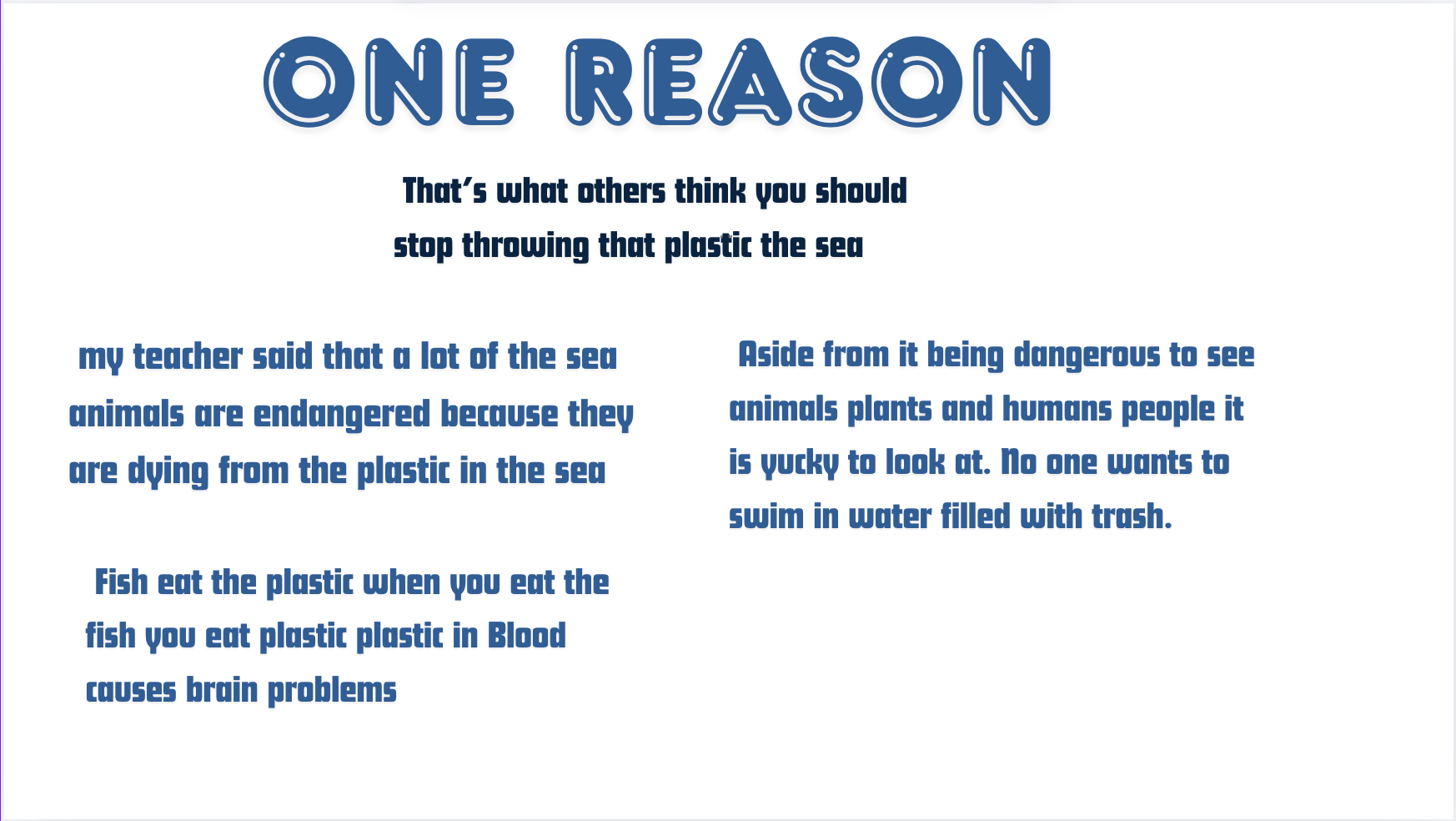
Student evidence of relying on one of the ‘core holdings’
The intervention worked because it extended a capacity she had rather than substituting for one she lacked. Had I simply given her the text read aloud, or modified the complexity, the output would have improved immediately and the reading circuit would have gone on not forming. The distinction between those two responses is why we must balance the core holdings so that if one is stronger than another, the person still continues growing.
Measure Beyond the Performance
The uncomfortable implication that stems from the developmental portfolio ultimately will arrive at assessment. When an AI tool is present, whatever we measure reads the student and the tool as a single unit. The summary is competent. The paragraph is fluent. The score often improves. None of it tells you what the student has built or cemented, because the measurement is assessing output.
A holding's value is what remains when technological scaffolding is removed. This does not require abandoning technology or running some kind of purity test but does requires that, at intervals, students do something unassisted, and that we pay attention to the gap between that and their assisted work. The gap is the information. A falling score at least tells the truth.
Development, like interest or debt, does compound, which is precisely why foreclosure is the major risk for students growing up mediated by AI tools. A capacity not built in one window is a thinner foundation under everything built on top of it.
Productive struggle is valuable because the effort of staying with a problem that creates some resisance is what constructs the capacity to solve the next one. Remove the struggle and you have removed the thing that was doing the building.
The case for a diversified portfolio rests on a child is building several distinct capacities on different developmental schedules, and a system that measures one of them well and the others not at all will report success while the portfolio concentrates and increases risk.
References
Cantor, P., Osher, D., Berg, J., Steyer, L., & Rose, T. (2019). Malleability, plasticity, and individuality: How children learn and develop in context. Applied Developmental Science, 23(4), 307–337.
Cook, T., & Nasir, B. (2026). Before the window closes: A developmental framework for education policy in the age of AI [Technical report]. ResearchGate. https://doi.org/10.13140/RG.2.2.24233.15204
Immordino-Yang, M. H., & Damasio, A. (2007). We feel, therefore we learn: The relevance of affective and social neuroscience to education. Mind, Brain, and Education, 1(1), 3–10.
Stanovich, K. E. (1986). Matthew effects in reading: Some consequences of individual differences in the acquisition of literacy. Reading Research Quarterly, 21(4), 360–407.
