
Why AI is Not a Calculator: 3 Flawed Education Analogies
Three analogies for AI show up in nearly every conference session, LinkedIn post, PD workshop, and policy conversation I sit through.
AI is like the printing press. AI is like a calculator. AI is like Google.
The people saying the comparisons are not uninformed. Often, they are school leaders, university professors, and policy advisors. But these analogies are wrong in the same way, for the same reason because they are not arguments about technology, but inadvertent permission structures for institutional inaction.
The Printing Press Analogy:
We adapted to writing, we adapted to print, we will adapt to AI. Technology arrives, society panics, society adjusts.
And this is actually quite true about every tool in the sequence. Writing did externalize memory. Printing externalized distribution and Search externalized retrieval. In each case, the tool handled a mechanical function, and the human redirected freed capacity toward harder cognitive work.
But let’s consider the difference. The printing press gave you Aesop's Fables so you could read about a tortoise and a hare. You followed the story but arrived at the lesson yourself, through your own reading of it.
AI does not hand you the story. AI tells you "this is a fable about a persistent tortoise racing an arrogant rabbit, and the lesson is that consistency beats talent." The lesson shows up pre-digested, thus, the cognitive work of extracting meaning from narrative, the part that builds comprehension, inference, and interpretive judgment, never happens. The printing press externalized distribution. AI externalizes the reasoning. The sequence breaks when the variable being offloaded is the one that made every prior adaptation possible.
The Calculator Problem
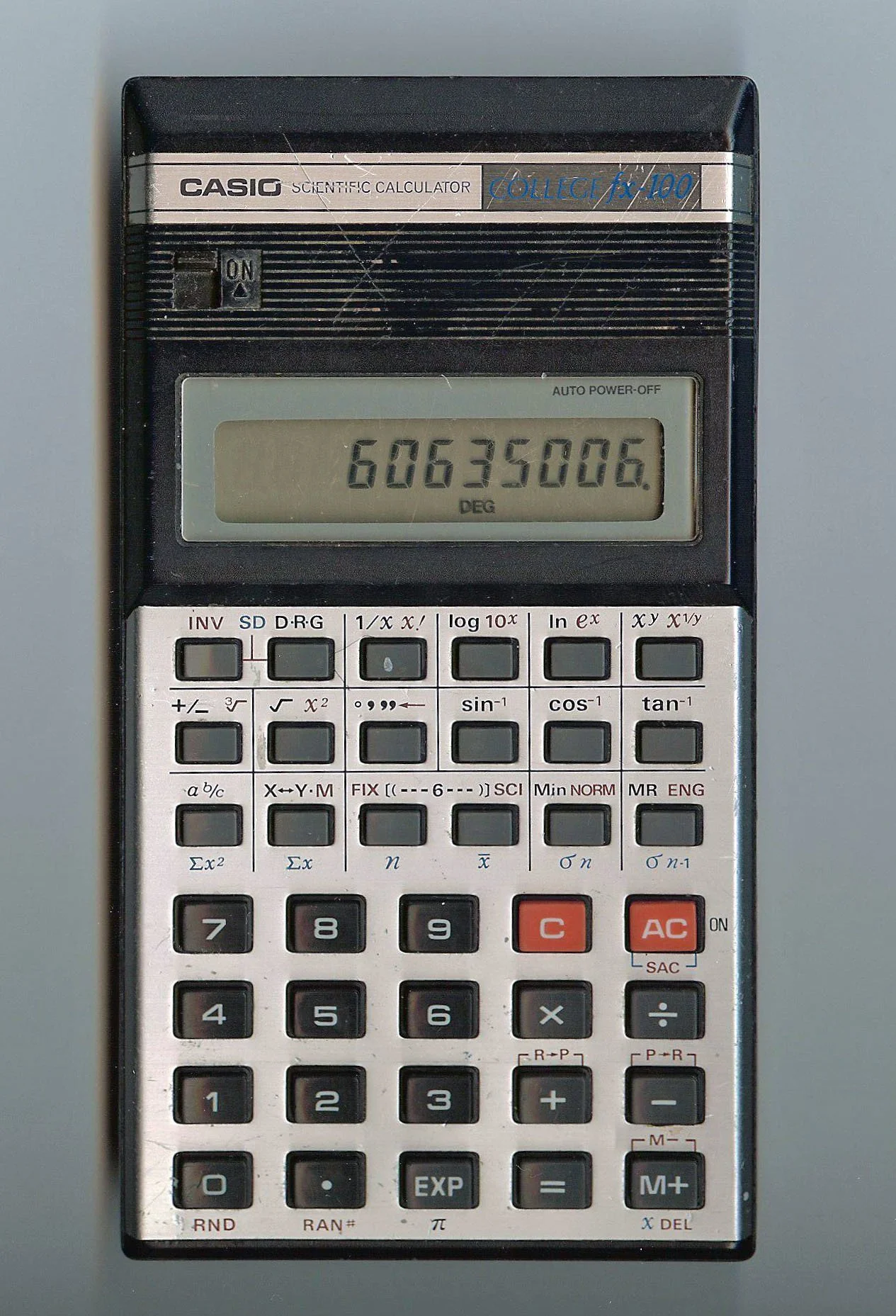
“Calculators didn't destroy math. They freed us for higher-order thinking.” - said atleast one hundred people to me. This is Also true.
But try this. Use a calculator right now to compute the difference between a 4.1 magnitude earthquake and a 7.3 magnitude earthquake. Then determine how that difference would affect a small city.
If you do not already know that earthquake magnitudes are calculated on a logarithmic scale where each whole number represents a tenfold increase, the calculator is of no use to you. You would not even know what function to enter. The calculator requires you to possess the conceptual knowledge before it can execute the operation.
AI will answer both questions instantly, fluently, and without requiring you to know any of it. That is the category difference the analogy hides. A calculator executes your reasoning. AI replaces it.
The analogy persists because it lets institutions deploy AI without asking whether students possess the cognitive scaffolding to audit what the tool produces. For most students encountering material for the first time, they do not.
The Google Effect, Revisited
We worried search engines would make us lazy, but they just changed what we needed to memorize. Everyone has already experienced why this comparison fails.
You have used both Google search and Google's AI overview. They both give you information. One returns links you curate on your own. You evaluate sources. You decide what is credible. You synthesize across tabs. The other curates for you. It delivers a pre-assembled answer and asks nothing of your judgment. Same company. Same search bar. Two categorically different cognitive events.
Betsy Sparrow and colleagues showed in 2011 that people who expected to search for information later invested less effort in encoding it (Sparrow et al., 2011). We treated the finding as benign because the adults in the study still retained the reasoning skills they had built before search existed. The tool changed what they stored. It did not change how they thought.
The policy and privacy dimension of this argument lives at the Cognitive Privacy Project.
But the Google Effect was studied in adults with the original search model, not the AI synthesis model. It described a shift in storage strategy among people who already possessed the knowledge architecture to decide what was worth storing and what could be retrieved. A child does not have that architecture.
A child encountering AI synthesis is not making a storage decision. She is encountering the tool during the years when the architecture itself is supposed to be under construction. The decision about what to offload requires a cognitive scaffold that offloading prevents from forming. The circle is the problem.
What the Analogies Protect
Every one of these comparisons borrows the resolution of a prior panic and implies the current concern will resolve the same way: through adaptation, over time, without requiring anyone to change what they are currently doing.
The analogies are arguments against intervention. If AI is just the next calculator, no school board needs to slow deployment. No curriculum committee needs to revisit sequencing. No institution needs to answer whether the tool should come before or after the cognitive capacity it depends on.
Gerlich's 2025 study found that adults over 46 showed higher critical thinking alongside lower AI reliance, while participants aged 17 to 25 showed the inverse (Gerlich, 2025). The older group offloaded tasks they had already learned. The younger group offloaded tasks they never learned to perform. That is not adaptation. That is a generation assembling its intellectual foundation from outputs it cannot verify, during the biological window when the capacity for verification is supposed to form.
The analogies make that sentence sound dramatic but should sound diagnostic. The analogies feel true because they are true about every tool that came before. They are being applied to the first tool that breaks the pattern. The gap between a technology that externalizes what you know and a technology that externalizes how you think is the gap the analogies exist to avoid seeing.
The printing press did not read the book for you. The calculator did not decide what to compute. Google did not evaluate what it retrieved.
AI does all three. And we are deploying it to children who have not yet built the capacity to notice.








The developing brain works in a way close to this. It grows far more synaptic connections than it will keep and then prunes the ones experience does not reinforce, holding on to the pathways that get used and insulating them with myelin so they connect more thoroughly and a re harder to lose.